
As Osun State approaches another governorship election, the campaign season has once again brought competing visions for the state’s future. Beyond party affiliations and political rhetoric, the electorate is confronted with a more enduring question: what qualities should define the next phase of leadership in Osun?
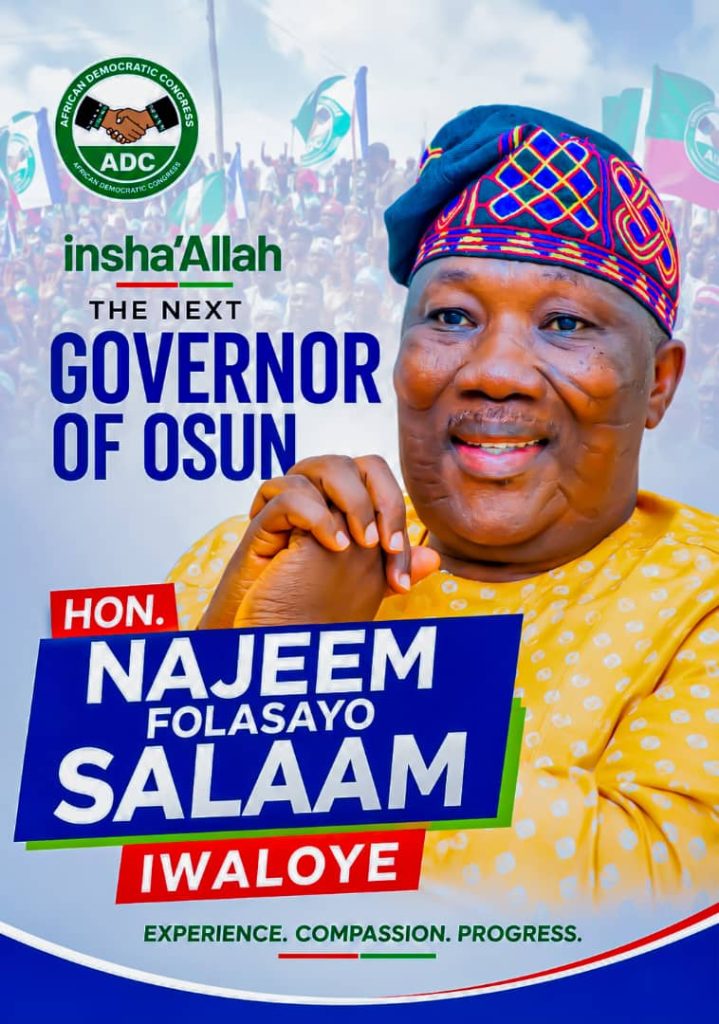
For supporters of Dr. Najeem Folasayo Salaam, the governorship candidate of the African Democratic Congress (ADC), the answer lies in a model of governance anchored on competence, inclusiveness, and service to the people. His campaign has sought to distinguish itself by emphasising policy conversations over political hostility, projecting an image of leadership that places dialogue and practical solutions above divisive rhetoric.
Rather than engaging in personal attacks or inflammatory exchanges, Dr. Salaam has taken his message directly to communities across the state, presenting what he describes as a roadmap for rebuilding public confidence in government. This approach reflects an understanding that democratic leadership is strengthened not by political grandstanding but by meaningful engagement with citizens.
His policy agenda is built around sectors that directly influence the quality of life of the people. Education occupies a prominent place, with proposals aimed at providing free and quality primary and secondary education to ensure that economic circumstances do not prevent children from accessing learning opportunities. Complementing this is a commitment to healthcare, particularly for children, pregnant women, and senior citizens, recognising that improved public health remains fundamental to sustainable development.
Economic revitalisation also features prominently. Agriculture is projected as a strategic driver of employment, food security, and industrial growth through improved support for farmers, access to finance, modern farming techniques, and investment in agro-processing. Infrastructure development, including roads, water supply, and electricity, is equally presented as an essential foundation for attracting investment, supporting businesses, and stimulating broader economic activity.
A key pillar of Dr. Salaam’s manifesto is the provision of stable electricity to power homes, industries, and businesses across Osun State. Reliable electricity would reduce business costs, attract investment, support small and medium-sized enterprises, encourage industrial growth, and create employment opportunities for thousands of young people. By improving power supply, his vision seeks to unlock Osun’s economic potential and accelerate sustainable development.
Security remains an indispensable component of development. No economy thrives where citizens live in fear or where businesses cannot operate with confidence. Dr. Salaam’s emphasis on community-based security, stronger collaboration with law enforcement agencies, intelligence gathering, and partnership with traditional institutions reflects the recognition that peace and stability are prerequisites for meaningful economic and social progress.
Another significant aspect of his agenda is the inclusion of women in governance and development. Expanding opportunities for women in leadership, entrepreneurship, and public service is presented not merely as a matter of equity but as a strategic investment in stronger institutions and more responsive governance. Societies that harness the talents of all citizens are generally better positioned for sustainable growth.
Youth development receives similar attention. With investments proposed in education, vocational training, digital skills, entrepreneurship, innovation, sports, and employment creation, the vision acknowledges young people not simply as beneficiaries of government programmes but as partners in shaping the future of the state.
Supporters further point to Dr. Salaam’s personal attributes—his legislative experience, administrative background, accessibility, humility, and intellectual capacity—as qualities that could strengthen governance in a state seeking renewed direction. Whether these qualities ultimately resonate with voters remains a democratic decision, but they form an important part of the narrative surrounding his candidacy.
Ultimately, elections should provide citizens with the opportunity to evaluate ideas, leadership capacity, and competing development strategies. The campaign of Dr. Najeem Folasayo Salaam presents one such vision—centred on education, healthcare, agriculture, infrastructure, stable electricity, security, youth empowerment, women’s inclusion, transparency, and accountable governance.
The choice before the people of Osun extends beyond personalities or political parties. It is, fundamentally, a choice about the kind of governance capable of advancing the collective aspirations of the state. If democratic contests are to serve their highest purpose, they must encourage informed decisions based on programmes, competence, and the public interest.
Whether Dr. Najeem Folasayo Salaam’s vision ultimately earns the mandate of the electorate will be determined at the ballot box. What remains beyond dispute is that issue-based campaigns and constructive engagement enrich democracy and strengthen public confidence in the electoral process.