
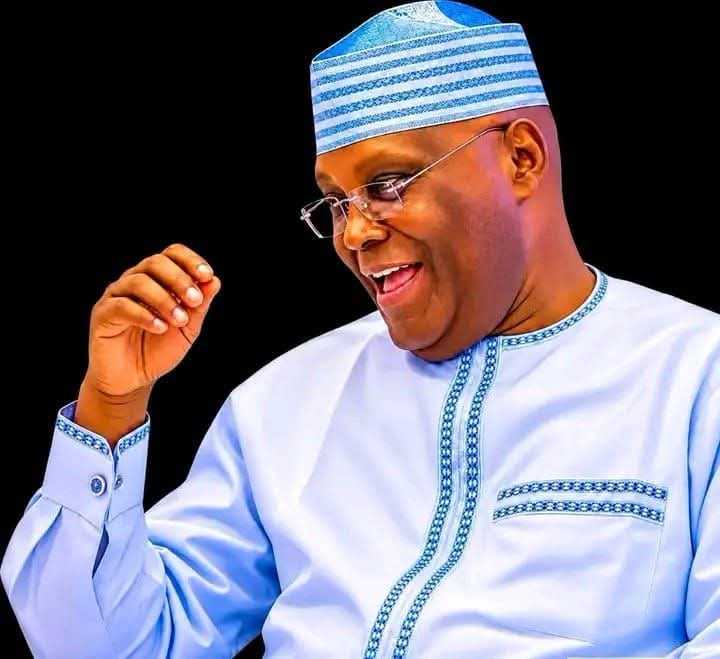
Sometimes, our political convictions are shaped by things we read, things we hear, people we meet and, occasionally, experiences we never forget.
My relationship with Alhaji Atiku Abubakar’s politics dates back to 2005/2006, when the political feud between President Olusegun Obasanjo and his Vice President, Atiku Abubakar, became particularly intense.
I was an undergraduate at Olabisi Onabanjo University (OOU), Ago-Iwoye, Ogun State, studying Law. I was probably in my 300 or 400 level at the time. Today, I am a lawyer, but some of my earliest and most memorable political experiences date back to those university days.
Those who attended OOU around that period will remember the arguments and political discussions that took place at the Vendors’ Stand at the campus gate, OlopomerinJunction, Ita Merin Junction and Abobi Junction. These were some of our regular meeting points.
We converged there almost every day to discuss, argue and sometimes quarrel over Nigerian politics.
At the time, Obasanjo enjoyed considerable support in Ogun State. After all, he was our son, a Yoruba man and, more specifically, an Egba man. Many students naturally gravitated towards him because of these affiliations.
But I was on Atiku’s side.
My position was not necessarily because I knew Atiku personally. I had never met him. Rather, being the son of a journalist, I had access to information beyond rumours, beer-parlour discussions and the usual political sentiments.
My father, Otunba Adesegun Sode, was the Editor-in-Chief of the Nigerian Tribune between 1997 and 2000. Growing up with a father who occupied such an important position in the Nigerian media industry exposed me to political discussions, journalism and the importance of information.
I grew up appreciating the value of independent thinking and looking beyond the sentiments that often dominate political conversations.
At the time, the PDP had become so dominant that there was practically no visible opposition capable of challenging its internal power structure.
Consequently, the party’s internal disagreements became a major national crisis.
The National Assembly, the police, the military and even the judiciary appeared divided along the political lines created by the Obasanjo-Atiku disagreement.
From my perspective, Obasanjo was determined to use the enormous powers of his office against Atiku, but Atiku was fighting back with everything he had.
One particular development that I found remarkable was the treatment of Atiku’s aides. Obasanjo reportedly dismissed the aides attached to the Vice President, and Atiku subsequently , paying them from his personal resources.
I have often wondered whether he was ever adequately compensated for the financial burden he carried during that period.
There was also the controversy surrounding Obasanjo’s attempt to remove Atiku as Vice President and the reported announcement of Senator Jubril Aminu as a replacement. Atiku challenged the action in court and won.
Then came the third-term controversy.
Obasanjo’s attempt to secure a third presidential term generated enormous opposition. Atiku and several other political figures stood against the project.
The political consequences were significant. Governors perceived to be close to Atiku came under pressure, and the struggle increasingly extended beyond the presidency into other institutions of government.
It was a period when the concentration and exercise of presidential power became a major national concern.
Throughout this period, I was one of the most vocal defenders of Atiku at the Vendors’ Stand.
We argued almost every day. Sometimes the arguments became so heated that we insulted one another and even exchanged threats. It was not always civil, but that was how passionate political discussions were in those days.
One day, out of the blues, a professor, Prof. Onabamiro, called me by my name.
I had never met him personally. I knew him because he was a very popular professor on campus, but I had never taken any of his courses.
I was therefore surprised that he knew my name.
He called me aside and advised me to stop my open and passionate support for Alhaji Atiku Abubakar.
He explained that what I was doing could get me into serious trouble.
His argument was simple: This was Ogun State. Why was I taking such risks with my life by supporting a Northerner against the political interests of our own son, Obasanjo?
He warned that, considering the political atmosphere, I could be arrested, attacked, maimed or even rusticated if powerful people decided to make an example of me.
I was angry.
How could anybody ask me to abandon my convictions simply because another politician came from my state? Was I not also from Ogun State? Was this not a democracy? Did being Yoruba or Ogun State indigene mean I had surrendered my right to freedom of expression and political choice?
I immediately called my father, Otunba Adesegun Sode, to tell him what had happened.
His advice was that I should continue my advocacy and exercise my constitutional right to freedom of speech.
That was exactly what I intended to do.
THE PHONE CALL THAT CHANGED EVERYTHING
One day, while I was on my way home, my phone rang.
The caller said:
“Assalamalaykum. My name is Alhaji Atiku Abubakar.”
Now, remember that this was the period when Yahoo Yahoo and telephone scams were very common in Nigeria.
I immediately assumed that somebody was trying to scam me.
I had never met Atiku. I did not know him personally, and I certainly did not expect the Vice President of Nigeria to call an undergraduate like me.
So I cut him off and insulted him.
I told him he was stupid and should go and look for a rich person to scam because I was just a bloody student.
The person called again.
I was still angry and equally rude.
After the third time, another number called. This time, the caller introduced himself:
“Is your name Folarin Sode?”
I answered yes.
He said:
“My name is Mr Akande. I am an SA to Alhaji Atiku Abubakar, the Vice President of the Federal Republic of Nigeria. He called you earlier, and you were rude to him. He will call you again. Please accord him his deserved respect.”
At that moment, I almost urinated in my pants.
Atiku Abubakar had called me?
A small undergraduate like me?
And I had called him a scammer and insulted him?
I was in trouble!
When the call came again, I answered properly. In fact, I probably overdid the respect. I kept apologising and shouting, “I am sorry, sir!”
He then explained why he had called.
He told me about Prof. Onabamiro and how the professor had informed him about a young, fanatical supporter at OOU who was putting his academic career and future at risk because of his support for Atiku.
According to him, the professor was his friend and had expressed concern that I was unwilling to listen to advice. That was why he decided to reach out to me personally.
What he told me next has remained with me for years.
He explained that he and his boss, General Olusegun Obasanjo, were adults and politicians. They had both reached the pinnacle of their political achievements, and neither could cancel the other.
He said that although they were enemies at that moment, they could become friends again in the future. That was how politics worked.
He advised me not to sacrifice my education, career and future over a political disagreement between two adults who were capable of fighting their own battles.
He appreciated my support but said he would not want me to become a victim because of him.
He practically begged me to let things go, assuring me that he was capable of handling his own political battles.
I was stunned.
Here was a sitting Vice President of the Federal Republic of Nigeria calling an undergraduate, not to recruit him, not to threaten him and not to demand loyalty, but to tell him not to destroy his future because of a political disagreement.
That conversation changed something in me.
I had supported Atiku based on what I had read about him, his political positions and the courage I believed he demonstrated during that period. But after that telephone conversation, my admiration became personal.
That was how I became a lifelong supporter of Alhaji Atiku Abubakar.
The story did not end with that telephone conversation.
Atiku subsequently invited me to meet him at Bourdillon, Lagos, the residence of Asiwaju Bola Ahmed Tinubu.
My understanding was that Atiku wanted to introduce me to Tinubu as an example of a Yoruba supporter who had admired and supported him even before the formation of the Action Congress (AC).
Unfortunately, the Lagos Cabal subsequently claimed that I was one of their boys whom they had planted at OOU to support Atiku, just as they allegedly had people in other institutions.
That was not true. They made him believe i was one of the people on their payroll who is supporting Atiku because of them.
I was not planted by anybody. I was an independent undergraduate who had developed his political convictions from what he knew, read and believed.
Atiku eventually left me with the Lagos AC people, believing I was part of their political structure based on the information he had been given. Unfortunately, I lost contact with him after that encounter, and we remained out of touch for years until his son, Mustapha (Musty) Atiku, reintroduced us years later (another interesting episode).
I later came to understand that politics sometimes creates its own narratives, and people are often eager to take ownership of things they did not necessarily create.
WHY I AM TELLING THIS STORY
I have supported Alhaji Atiku Abubakar since that period.
I have never claimed that he is perfect, nor am I suggesting that anybody must agree with my political choices.
But I have a personal experience that shaped my perception of the man.
I remember a Vice President who was in the middle of one of the fiercest political battles in Nigeria’s history, yet found time to call an undergraduate because somebody had warned him that the young man was putting his future at risk.
He did not ask me to fight harder. He did not encourage me to become more confrontational. He asked me to protect my future.
That is a conversation I have never forgotten.
I also remember the political circumstances surrounding his disagreement with Obasanjo, including the controversy over the third-term project and the sacrifices made by people who stood on different sides of that struggle.
There is another part of Atiku’s political history that I find particularly interesting.
I remember his disagreement with the Northern political establishment over the Sharia controversy during Obasanjo’s presidency. Atiku stood with his boss at a time when some Northern governors were using the Sharia debate to challenge the President politically.
My interpretation is that this contributed to the political difficulties he subsequently experienced in parts of the North. Buhari, who supported the Sharia position at the time, attracted a different kind of political following among many Northern voters.
These are some of the historical and political considerations that shaped my understanding of Atiku’s journey.
As another election approaches, I know that many stories, accusations and counter-accusations will circulate about him. That is politics, particularly during an election season.
People are entitled to their opinions, and Nigerians should examine every politician critically.
But before people dismiss him based solely on political narratives, I would like them to give him an opportunity to present himself and his ideas.
My support for Atiku did not begin yesterday.
It did not begin because somebody promised me an appointment, money or political relevance.
It began in 2005/2006, at the Vendors’ Stand at the campus gate of Olabisi Onabanjo University, Ago-Iwoye, where a young Law undergraduate from Ogun State was arguing with fellow students in defence of a politician he had never met.
And it was cemented by a telephone call from that same politician, a call I initially dismissed as a Yahoo Yahoo scam!
That is my story.
I invite fellow Nigerians to give Alhaji Atiku Abubakar a chance to show us who he is and what he has to offer in 2027. Trust me, you won’t regret it.
God bless Nigeria.
Folarin Sode is a Practicing Lawyer in Lagos.
folarinsode@gmail.com