“Under the administration of President Bola Ahmed Tinubu, Aregbesola has become one of Nigeria’s most visible voices advocating political renewal, internal party democracy and accountable governance. His political journey has taken an extraordinary turn—from being one of the most influential architects of progressive politics in the South-West to becoming one of the most prominent advocates for an alternative democratic vision. Few politicians have embraced such a path with equal determination. The significance of Aregbesola’s activism lies not merely in his criticism of the status quo but in his unwavering insistence that democracy must never become an echo chamber where dissent is mistaken for disloyalty. Every thriving democracy depends on courageous men and women who are prepared to question prevailing orthodoxies, challenge established interests and remind those in authority that power ultimately belongs to the people”
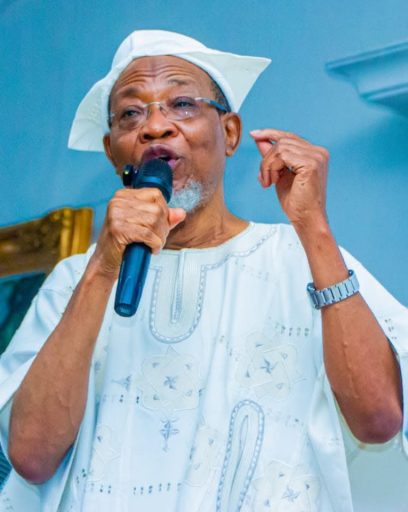
In politics, there are men who merely occupy offices, and there are those who shape history by refusing to surrender their convictions. Ogbeni Rauf Aregbesola belongs unmistakably to the latter category. Whether admired or criticised, he has emerged as one of the most consequential political actors in Nigeria’s Fourth Republic, demonstrating that the true test of leadership is not blind conformity but the courage to stand firmly by one’s principles when the political tide turns.
Under the administration of President Bola Ahmed Tinubu, Aregbesola has become one of Nigeria’s most visible voices advocating political renewal, internal party democracy and accountable governance. His political journey has taken an extraordinary turn—from being one of the most influential architects of progressive politics in the South-West to becoming one of the most prominent advocates for an alternative democratic vision. Few politicians have embraced such a path with equal determination.
The significance of Aregbesola’s activism lies not merely in his criticism of the status quo but in his unwavering insistence that democracy must never become an echo chamber where dissent is mistaken for disloyalty. Every thriving democracy depends on courageous men and women who are prepared to question prevailing orthodoxies, challenge established interests and remind those in authority that power ultimately belongs to the people.
Throughout his political career, Aregbesola has cultivated a reputation as an ideologue rather than a transactional politician. From his years as Governor of Osun State to his tenure as Minister of Interior, he consistently projected politics as an instrument for social transformation rather than personal enrichment. Even those who disagree with his present political choices rarely question the intensity of his convictions or the consistency with which he pursues them.
Today, as Nigeria grapples with economic hardship, rising public expectations and increasing demands for good governance, Aregbesola’s interventions have injected fresh energy into the national political conversation. His message has remained remarkably consistent: political parties must rediscover their ideological soul, governments must become more accountable to citizens, and leadership must be measured by service rather than political dominance.
Perhaps the greatest strength of his current activism is its affirmation that democracy is larger than political parties and more enduring than personal alliances. Political relationships may evolve, alliances may shift and circumstances may change, but the right to hold independent political convictions remains one of democracy’s greatest safeguards.
Aregbesola’s willingness to chart an independent political course illustrates a rare quality in contemporary Nigerian politics—the readiness to embrace uncertainty in defence of principle. Such choices are seldom easy. They demand resilience, sacrifice and an uncommon confidence in one’s political philosophy. Yet history repeatedly demonstrates that democratic progress often begins with individuals prepared to challenge comfortable assumptions.
Nigeria’s democracy should welcome—not fear—robust political competition. Healthy opposition is not an obstacle to governance; it is one of its greatest assets. Governments perform better when citizens have credible alternatives, and political leaders become more responsive when they recognise that public confidence must continually be earned rather than assumed.
The measure of a democrat is not whether he always agrees with those in authority, but whether he remains committed to constitutional engagement, peaceful political participation and the supremacy of the ballot box. In this regard, Aregbesola’s continued engagement within Nigeria’s democratic process reinforces the enduring strength of constitutional politics over political intimidation or personal bitterness.
Of course, opinions about Ogbeni Rauf Aregbesola remain deeply divided. Supporters see him as a principled reformer whose courage has reinvigorated democratic debate. Critics contend that his political choices have complicated the progressive movement he once helped build. Such divergent views are not signs of democratic failure; they are evidence that democracy is alive, vibrant and capable of accommodating competing visions for Nigeria’s future.
Ultimately, history seldom remembers those who simply followed the crowd. It remembers those who expanded the frontiers of political thought, challenged complacency and inspired citizens to think beyond the limitations of the moment. Whether one applauds or questions his present political direction, Ogbeni Rauf Aregbesola has undeniably become one of the defining voices in Nigeria’s evolving democratic landscape.
As the nation journeys through another defining chapter of its democratic experience, his political activism offers a timeless reminder: democracy is strongest when ideas compete freely, when convictions outweigh convenience, and when leaders possess the courage to defend what they believe—even when the political cost is high.
In an age when political expediency often overshadows principle, Ogbeni Rauf Aregbesola has chosen a different path. Time alone will determine the ultimate verdict of history, but one fact is already beyond dispute: his activism has enriched Nigeria’s democratic conversation and ensured that the contest of ideas remains at the heart of the nation’s political evolution.
Nowinta Igbotako, a serial author, international conflict resolution expert, is the Executive – Director, Nigeria Good Governance Research Centre (NGGRC).